
Why Most All-Hands Meetings Fail to Engage Employees
All-hands meetings are designed to align organizations, but most rely too heavily on passive communication. Employees attend and listen, yet engagement remains shallow because participation is never required. This article explores why broadcast-style meetings fail to create lasting impact, how scale changes communication dynamics, and why participation is essential for turning organizational updates into shared understanding.
1/25/20264 min read
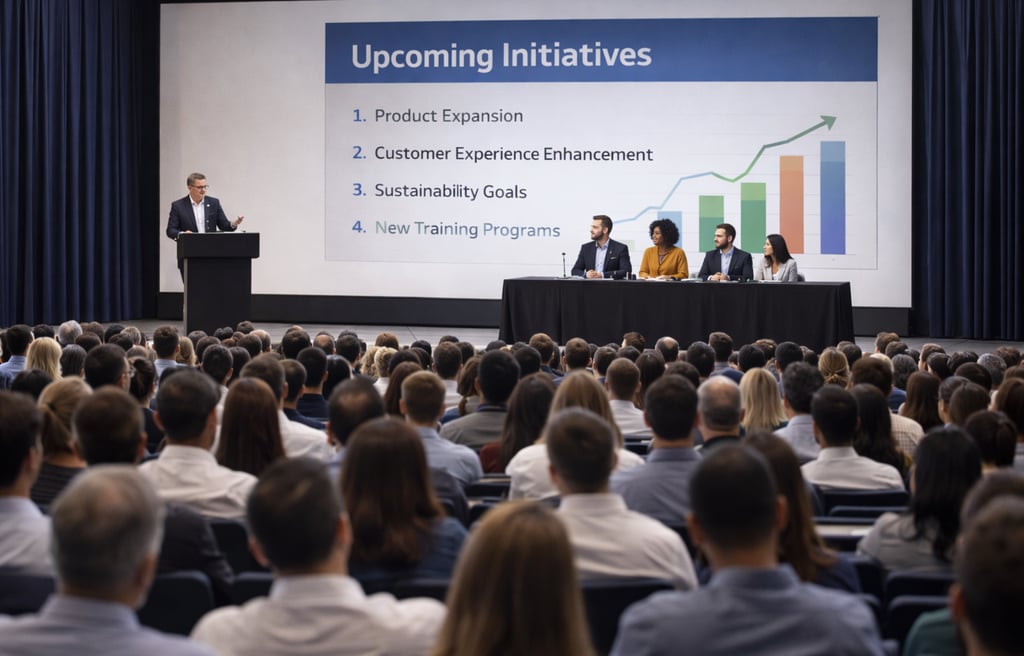
Information is shared. Attention is assumed. Engagement never forms.
The Meeting Everyone Attends but Few Truly Experience
All-hands meetings carry weight. They are meant to align teams, reinforce direction, and connect employees to the broader organization. Leaders prepare carefully. Slides are refined. Key updates are organized into clear narratives.
Attendance is rarely the problem. Employees join on time. They watch. They listen.
From a logistical perspective, the meeting succeeds. Information reaches the entire organization at once.
What remains unclear is whether that information actually lands.
In the hours and days that follow, conversations reveal uneven interpretation. Some employees feel energized. Others feel unchanged. Many struggle to connect the updates to their daily work. The meeting delivered information, but its impact fades quickly.
This outcome is so common that many organizations accept it as normal. In reality, it reflects a structural gap between communication and engagement.
Attention Cannot Be Assumed at Scale
All-hands meetings rely heavily on broadcast communication. One group speaks. Everyone else listens. This structure works efficiently for distributing information, but it does not guarantee attention.
Listening is a passive state. Employees can follow along without actively processing what they hear. The larger the audience, the easier it becomes for individuals to disengage quietly. There is no natural expectation of participation.
Leaders often rely on visible signals to gauge engagement. Cameras are on. Faces appear attentive. No one interrupts. These signals create reassurance, but they reveal little about whether employees are mentally present.
Engagement requires involvement. Without it, attention drifts naturally, especially when employees cannot see how the information applies directly to their role.
Information Alone Rarely Changes How People Feel
All-hands meetings are often designed to inform. Leaders share performance updates, strategic direction, and organizational priorities. These updates are important, but information alone rarely creates emotional investment.
Employees evaluate information through the lens of their daily experience. They look for relevance. They look for clarity on how changes affect their responsibilities. When that connection remains abstract, engagement remains shallow.
This does not reflect a lack of interest. It reflects a lack of participation.
When employees remain observers, they absorb information at a surface level. They may remember key announcements, but the deeper meaning and intent often fade quickly.
Engagement forms when employees actively process information, not when they simply receive it.
Scale Changes the Nature of Communication
All-hands meetings often involve large audiences. As the audience size increases, participation naturally decreases. Individuals become less likely to speak or ask questions. Responsibility for engagement shifts entirely to the presenters.
This dynamic creates distance between leadership and employees, even when communication is clear. Employees may understand what was said, but they do not feel involved in the conversation.
Over time, this distance reduces the effectiveness of all-hands meetings. Employees attend out of obligation rather than interest. The meeting becomes routine rather than meaningful.
This outcome is rarely intentional. It emerges from structure, not effort.
Engagement Requires Visible Participation
All-hands meetings become more effective when employees have moments to participate. Participation shifts the experience from observation to involvement. It requires employees to evaluate information, reflect on its meaning, and respond.
These moments do not need to be extensive. Even small opportunities for participation change attention. Employees become more mentally present when they expect to contribute.
Participation also provides leaders with visibility. Instead of assuming engagement, they can observe it. They can identify areas of clarity and areas of uncertainty. They can adjust communication while the audience is still present.
This creates alignment during the meeting itself, rather than hoping it forms afterward.
The Difference Appears After the Meeting Ends
The effectiveness of an all-hands meeting is measured by what happens next. In meetings built on passive communication, the impact fades quickly. Employees return to their work unchanged. Leadership must rely on follow-up communication to reinforce key points.
In meetings that create participation, the outcome feels different. Employees leave with a clearer understanding of direction. They feel connected to the conversation rather than separate from it. The information becomes part of how they think about their work.
This difference compounds over time. Organizations with engaging all-hands meetings maintain stronger alignment. Employees feel more connected to leadership. Communication becomes more efficient because clarity forms earlier.
All-hands meetings achieve their purpose not when information is delivered, but when understanding is shared.
What Effective Leaders Do Differently
Leaders who run effective all-hands meetings recognize that engagement does not happen automatically. They design the meeting with participation in mind, not as an afterthought.
Instead of relying solely on presentations, they create moments when employees respond. These moments shift attention immediately. Employees stop observing and begin evaluating. They consider what the information means, how it connects to their work, and where they stand.
This changes the dynamic of the meeting. Employees become active participants in organizational alignment rather than passive recipients of information.
Leaders also gain something equally valuable. They gain visibility. They no longer have to assume engagement based on silence or visual cues. They can see where clarity exists and where uncertainty remains. They can address gaps while the entire organization is present, rather than discovering them weeks later through inconsistent execution.
Over time, this changes how employees experience all-hands meetings. Attendance becomes more intentional. Attention becomes more consistent. The meeting becomes a moment of alignment, not just a place to deliver updates.
The difference is not dramatic in a single session. Its impact accumulates. Organizations that structure meetings around participation create stronger alignment, faster execution, and more connected teams.
All-hands meetings achieve their purpose when employees do more than listen. They achieve it when employees engage.
Aloftly focuses on helping modern teams improve clarity, alignment, and execution through structured participation.
© Aloftly.io
Elevate Everywhere Enterprises, LLC.